What are the four most common causes of foot pain?
Video Transcript: I wanted to find out about foot pain. What are the most common diagnoses? What are the causes? The most common ones?
So I found in the Physician and Sports Medicine Journal, 2004, Dr. Steven Stovitz, I think it's pronounced, and Dr. Chris Cozzi, hopefully got the pronunciation right, they came up with four diagnoses. And what they found out was not surprising.
Can you come down here and look at my foot, Liz, thank you? All four of these diagnoses, they feel the commonality, the common cause is a mechanical problem, and that the foot pronates, or it goes into a flat footed position with weight bearing or the activity. So it's associated with flat foot, but don't worry if you have flat feet doesn't mean you're going to have; get these. That's our explanation.
The four are, we're going to go through them one through four, and I'm just going go through each one so you'll just have to, if you think this first one is not your foot pain, go to the next one.
So number one, this is a big one. I think every therapist or doctor will agree. - Plantar fasciitis.
This is the one we most commonly probably see in the practice field. Typically diagnosed with this. Honestly, of these four, this is the one I know for sure. And the other three are like, I'm not super common with. Right, well, I've seen them and I pretty much agree. And I talked to Bob about this last week and he concurred. So anyways, let's go to plantar fasciitis.
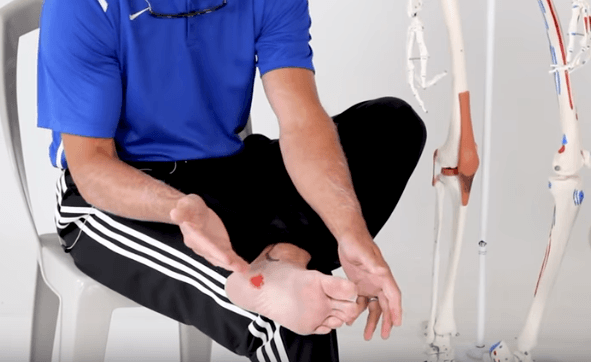
Typically the painful plane, the whole foot can be painful depending on how severe it is, but the primary source is this red dot right here on my foot. Liz said it looked like a little bit of blood, but don't worry, it's not, it's just a red marker.
So right there, when I see a patient, I will palpate and I'll go around here and I'll say, "Tell me when I hit the really tender spot." And almost always right there they go, "Oh! That's it!" So that's a common symptom that you can find on yourself.
Also, a common symptom is getting out of the bed in the morning and when you first put weight on it, it's very uncomfortable and you limp around for a bit. But then it starts to feel a little bit better after a few minutes of weightbearing or walking.
Two common symptoms. We're not going to go through all of these in detail as far as treatment, because it would be a 20 minute video or a 30 minute. We don't have that kind of time.
So, common treatments, Mike. Cold bottle is a very common one. Take a pop bottle, water bottle, whatever. Put it in the freezer, freeze it up, put it under your foot. And then... Roll on it. Make sure when you freeze it, there's a little air at the top, otherwise it'll expand and break your, your bottle and possibly get water in your freezer.
Yep. And another common thing is a night splint. That's kind of a splint you would put on your foot to keep it in more of a stretch position. Oh, you actually have one. We just did a video on the effectiveness of night splints for plantar fasciitis.So you can look that up.
So very common things to do at home are just icing and doing some stretching. If you're seeing a therapist, they might either do, I've seen iontophoresis or ultrasound, or different things as well. But just on your own, these are common things.
Number two, posterior tibialis tendonitis. That's a mouthful. So if we break it down, what it boils up to be is the posterior tib muscle. Well, let's get Sam out here.- Posterior means back.
So the back of the tibia, so it's in here. So in this area of the tibia and then the tendon actually wraps around the backside of your malleolus. I got a purple line here representing the tendon. And it connects up to the navicular bone. That's that bone that sticks out on the side there. And what that muscle does is when it contracts, it helps support your arch.
So this all is kind of coming together here. So if your arch collapses too much, it can cause that muscle to overwork and then that tendon can become inflamed and that's the tendonitis part.
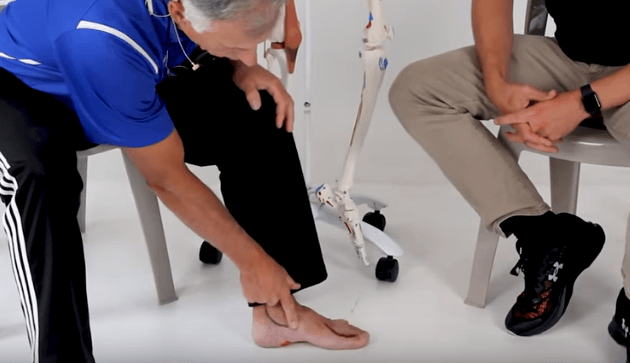
So down in here, symptoms are, if it hurts on the medial side or the inside of your ankle, and if you push on the backside, here's my malleolus, or that ankle bone, and I push on the backside of it here with this finger, You may find that to be quite tender there.
Good sign that that's part of your problem or it is your problem. So Mike, you got any, any clues for what you would do with that?
Well, you would probably put in a type of foot support. Yep. You can add in some kind of arch support, you don't have to get a custom one, you can just try getting something off the counter at, you know, online or at the local foot store.
And you're going to put it like, this is the insert from here, you will probably put it underneath the insert. Sometimes you take this one out and put the whole one in. Depends on, on what you're buying. But that supports that, allowing that tendon to have less stress on it, therefore getting it better. If it's real tender, you can put a cold pack on it, do that couple times a day and just be off of it.
Activities that irritate it, back off on them, you know, if you can. - Take some rest, strengthen the muscle a little bit too. Tibialis posterior typically inverts, so meaning it brings your foot in. You can do some just gentle range of motion. if it's really painful. You can always add some TheraBand for resistance if you really want to strengthen that.
But those are just some common options.- I believe we have a video specifically for this.
If you go Google bobandbrad flat-footed or tibi- posterior tibialis tendinitis, that should come up with much more details on the exercises. Number three, hallux valgus. - You take this one. - These are all the medical terms.
You'll know this more as people end up getting what's right here, Mike, they call that Bunion! Exactly, what happens is if you look at the line on my toe, I know my sister had this, is the toe ends up going, valgus means out, hallux just refers to the great toe, and it goes out this direction. So, and a lot of force gets put on this part of the foot. That causes the bunion and it can get bigger and the toe can actually go valgus more over time. It creates a real pain problem with walking.
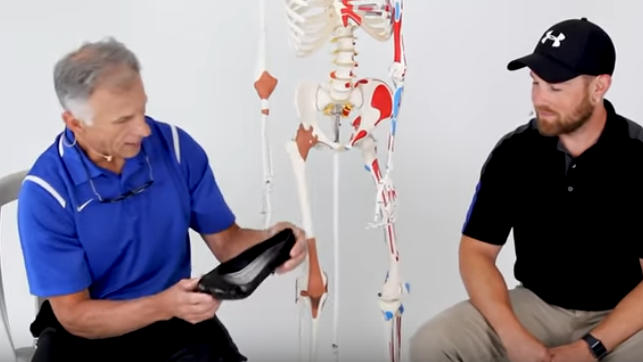
I find through the research, they find it 10 times more women get this then men, but there's a good reason. These types of shoes right here. This is my wife's shoe. She was fortunate. She said, go ahead and use it. I call them high heels. But I guess in the back in the day they called them pumps.
If your foot is in here and we got your heel elevated your weight bearing compresses the forefoot and it, you can see this actually forces it. It's like putting a brace on your foot or your big toe to move it in the wrong direction. It puts it out of neutral. And over time, if you wear these for years on end, you can develop the same problem that we just talked about.
That hallux, big toe, pointing inwards, then going to a bunion. So the best way to treat this, we really don't have a physical therapy regimen for this is get change your shoes.
Make sure you have wide forefoot or the toe box in the shoe so things have room in there. We take that stress off of there. If the bunion is too bad, you'll have to go to your podiatrist. They have ways to take care of that as well. - I think mine actually goes in a little more.
All right. And last but not least, another medical term, metatarsalgia. - So your metatarsal heads are this part of your foot basically. You have five of them. - Right, so it's on the bottom, too. This refers to pain on the bottom.
Now, Mike, you just mentioned you had a little episode of this, but the location of your pain? - Mine was on the fifth metatarsal head. It was the opposite foot, but I had recently gotten some different shoes and I was trying them out for the first time on a six mile hike and an eight mile hike in the mountains. So not the best way to break in some new shoes. But I had some really annoying pain afterwards for a few days. Now I don't wear those shoes and I'm fine, so... - Which oftentimes is the case with this diagnosis.
And in my case, I have pain right here, I put another red dot here. And if you have it right there below your fifth digit or the second to smallest toe, right about this location, and it hurts with walking, with weight bearing, it very likely could be Morton's neuroma. There's a nerve bundle in there. And it's a mechanical issue. If your toe box is too tight, that can irritate it. I have some other shoes that if the, the base of the foot where the insert is not shaped properly, puts pressure on there. It gets very painful.
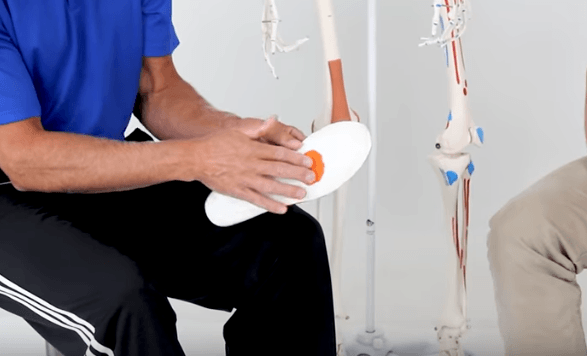
The nice thing about it is if you take your shoe off, pain goes away or quit walking on it and take the weight off it, pain goes away very rapidly. What I've done with my shoes, and we've got a video on this too, is I take my insert, pull it out of my shoe and where this orange is, I put in a cushion there. And that takes pressure, instead of going on the Morton's neuroma, that nerve bundle, it puts pressure in the arch. So you're just changing where the pressure location is, and it works quite well. And I just keep them in there. I put some tape over it so it doesn't move. And I have great success.
You can also, if it's really sore and I've done this after I've irritated it and it feels better, but it's still tender, I'll put a cold pack on it, put my foot on a cold pack while I'm, you know, reading something or watching the, watching the tube. So anyways, those are the things that are gonna help. Sometimes just a cushiony base, you know, insert without the, the custom made cushion can be adequate.
So, that's it Mike. Four diagnoses for foot pain. If you went through all of them, there's a good chance that your foot pain is from one of these.